
Transportation Engineer Input for Better Site Access
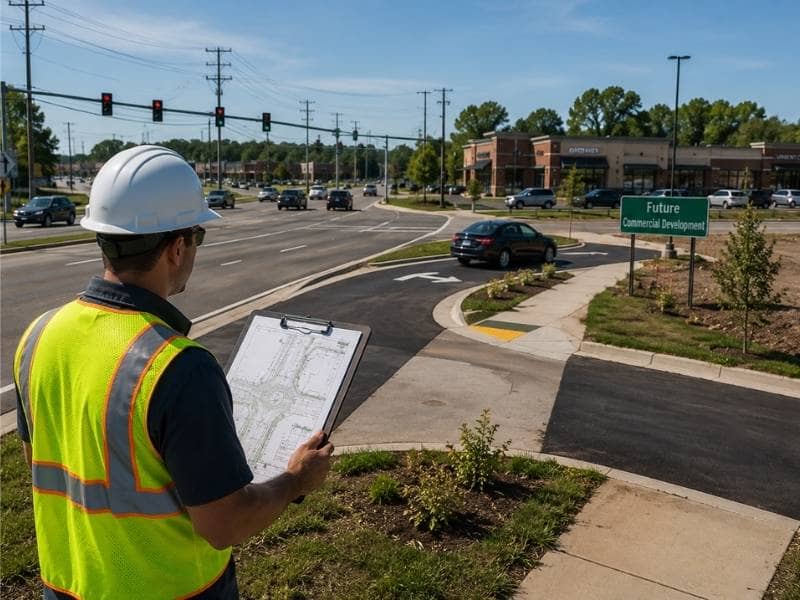
A property can look perfect until you try to drive into it. That’s the moment a transportation engineer earns the fee, because access decides whether a development functions or frustrates everyone who visits it. Traffic behaves in patterns, and those patterns don’t bend to fit a site plan someone drew without watching the road first. Owners who bring this expertise in early tend to get the driveway they want. Owners who bring it in late tend to get the driveway the reviewing agency will accept.
Evaluating Traffic Flow Before Site Development Begins
Roads carry habits. Morning commuters queue in one direction, delivery trucks turn at odd hours and school traffic spikes twice a day in short violent bursts. An engineer counts traffic flow and studies how vehicle movements stack up at nearby intersections, because a driveway that works at noon can fail badly at half past four.
Speed matters as much as volume. A high-speed road needs longer sight distance, since drivers approaching at fifty-five need far more room to react than drivers rolling along at thirty. Measuring that distance before a layout gets locked prevents an entrance from landing just past a curve or over a crest where nobody can see it coming.
Designing Safer Entrances Along Busy Roadways
Entrance design comes down to a few honest questions. Can a driver leaving the site see far enough in both directions? Can a truck make the turn without swinging into oncoming traffic? Will cars waiting to turn left block the through lane while they wait?
Answers come from geometry rather than opinion. Widening a throat so exiting vehicles don’t tangle with entering ones, adding a turn lane so left-turners get out of the way, shifting an entrance a hundred feet down the frontage to clear a signal queue. Small moves like these prevent the crashes that show up years later in an accident report. They also keep customers from avoiding a business because getting out of the lot feels dangerous.
Planning Access for Future Area Growth
Traffic counts taken today describe today. A site designed only around them will feel cramped the moment the next subdivision opens down the road. Engineers project forward instead, using approved developments, planned roadway work and population trends to estimate what the corridor will carry in ten or fifteen years.
That longer view changes real decisions. An entrance sized for future volumes may need extra storage length for turning vehicles, or a layout that leaves room to add a second access point later. Owners sometimes resist paying for capacity they don’t need yet. The alternative is rebuilding the entrance under traffic once the road fills up, which costs far more and shuts the driveway down while it happens.
Coordinating Site Access With Nearby Infrastructure
A driveway never exists alone. It sits among signals, medians, sidewalks, bus stops, bike lanes and the neighbor’s entrance forty feet away. Placing a new access point without accounting for those features creates conflicts that show up the first week a business opens.
Coordination usually means spacing driveways far enough apart that turning movements don’t overlap, keeping entrances clear of crosswalks and pedestrian ramps, and lining up with existing openings across the road so cars aren’t crossing paths at odd angles. Utilities complicate things further, since a pole or a buried line can rule out the exact spot the layout wanted. Working through those constraints early usually produces a workable answer. Discovering them during construction usually produces a redesign.
Supporting Development Reviews With Transportation Analysis
Agencies rarely approve access on faith. They want to see trip generation numbers, turning movement counts, sight distance measurements and a clear explanation of how the site handles the traffic it creates. A well-documented study gives reviewers something to agree with rather than something to argue about.
Good analysis also gets ahead of the objections. If a reviewer worries about queuing at a nearby signal, the study should already show what the queue does and how the design responds. Developments that arrive with those answers move through review noticeably faster, and they arrive at approval without the conditions that a nervous agency attaches to a thin submission.
Frequently Asked Questions
When should a transportation engineer become involved in a development project?
Before the site layout gets fixed. Access constraints influence where buildings, parking and internal drives can reasonably go, so late input often forces a rearrangement of things the design team already settled. Bringing the engineer in during early concept work keeps the layout and the access strategy compatible from the start.
How does a transportation engineer improve site access?
By treating the driveway as part of the road rather than part of the parking lot. The work covers sight distance, entrance width, turn lane needs, driveway spacing and how vehicles move once they’re inside the property. Each of those choices affects how safely and smoothly drivers get in and out.
Does every commercial development require transportation engineering?
No. A small building on a quiet street with an existing entrance may need nothing more than a standard driveway permit. Requirements grow with traffic. Sites that generate heavy volumes, sit on busy corridors or request new access along a major road almost always need a formal study before an agency signs off.