
Professional Engineer Review for Smarter Site Decisions
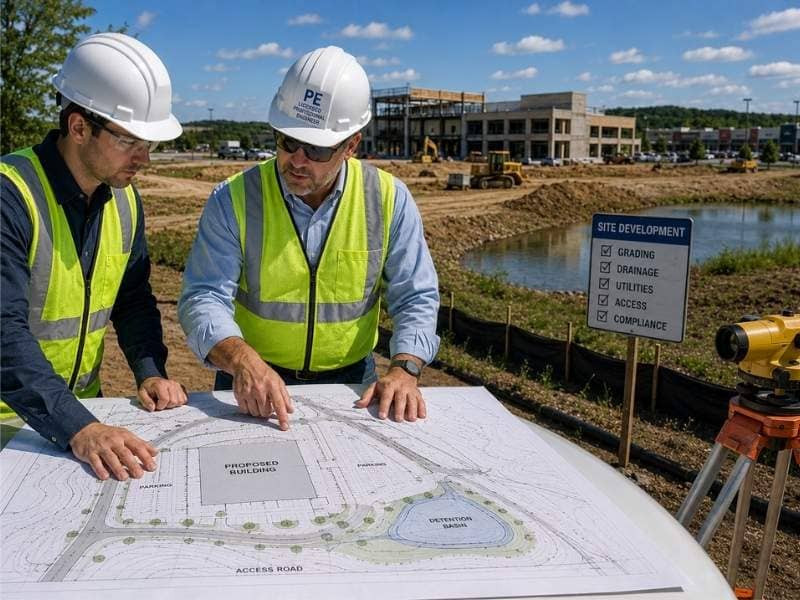
A professional engineer, or PE, is a licensed expert who makes sure a development project is safe and sound before crews break ground. They review the land, the plans and the risks, then put their license behind the work. On a site project, that stamp of approval carries real legal and practical weight.
What a Professional Engineer Does on a Project
A professional engineer holds a state license that only comes after years of hard work. The path runs through an engineering degree, two national exams and about four years of experience under another licensed professional engineer. That training is why a professional engineer can look at a raw piece of land and see what it will take to build there safely.
On a development project, a professional engineer checks that the design will actually work in the real world. They confirm the site can handle its own water, that the ground can carry the load and that the plans meet local codes. They also weigh cost and buildability, so a design looks good on paper and holds up in the field. When a professional engineer signs off, they’re saying the work meets a professional standard, and they’re staking their license on it.
Review the Site Before Building
Before a design goes far, a professional engineer takes a hard look at the whole site. They study the shape of the land, how water drains, where utilities run and how trucks and cars will get in and out. Each of these can make or break a project, and they often clash with one another. A driveway in the wrong spot or a utility line under a planned building can force an expensive redesign.
The real value shows up in catching these conflicts early. A professional engineer who spots a drainage problem or a bad access point during the review can fix it with a few edits to a drawing. The same problem found during construction can stop the whole job and cost a fortune. Time spent on a careful review up front almost always pays for itself many times over.
Get Through Permits and Site Reviews
Permit offices don’t just take a developer’s word that a plan is sound. In most places, the drawings a developer submits for approval have to carry the seal of a licensed professional engineer. Only a professional engineer can prepare, sign and seal those plans for a public authority, and that seal tells reviewers a qualified expert stands behind the design. Without it, many projects can’t even start the review.
A professional engineer does more than stamp paper, though. They speak the reviewer’s language and can answer tough questions on the spot, which keeps the approval moving. Before a purchase, a professional engineer can also run due diligence on a property and flag risks a buyer might miss. A plan that arrives complete and clearly explained tends to clear review faster than one full of gaps.
Solve Problems Before Construction Starts
Even a good-looking plan can hide problems that only an experienced eye will catch. A professional engineer reviews the design for issues like a slope that’s too steep to build on, a code rule the plan misses or two systems that fight for the same space. These are the kinds of things that look fine in a drawing and turn into a mess on the job site.
Catching them early gives the team room to choose the best fix, not just the fastest one. A professional engineer can often offer a few ways to solve a problem, then explain the trade-offs of each. That beats discovering the issue mid-build, when every option is costly and the clock is running. A short delay on paper is far cheaper than a work stoppage once crews are on-site.
Work With the Whole Project Team
No professional engineer works alone, and a big part of the job is keeping everyone rowing in the same direction. The surveyor maps the land, the architect designs the building and the contractor builds it, but their pieces have to fit together. A professional engineer sits in the middle of that group and makes sure the engineering ties all of it into one workable plan.
Good coordination keeps small gaps from turning into big ones. When the survey, the design and the site work all match, the developer avoids the costly surprises that come from crossed wires. The professional engineer often acts as the translator between the technical side and the business side, so the developer understands what each choice means for cost and schedule. A team that talks early and often tends to finish on time and on budget.
Frequently Asked Questions
What is a professional engineer?
A professional engineer, or PE, is an engineer who holds a state license to practice. Earning it takes an engineering degree, two national exams and years of supervised work. The license is proof that the engineer meets a high bar for skill and public safety.
What does a professional engineer do?
On a development project, a professional engineer reviews the site and the design to make sure everything is safe and buildable. They check drainage, grading, utilities and code rules, then seal the plans that go to the permit office. In short, they take responsibility for the work being done right.
When should I hire a professional engineer?
As early as you can, ideally before you buy the land. A professional engineer can spot deal-breaking problems during due diligence and shape the plan from the start. Bringing one in late means paying to fix issues that an early review could have caught on paper.
Can a professional engineer help with permits?
Yes, and on most site projects you can’t get a permit without one. Only a licensed professional engineer can sign and seal the engineering drawings that a public authority will approve. A PE also answers the reviewer’s questions, which helps the whole approval move faster.
Why is a professional engineer important for site development?
A professional engineer keeps a project safe, legal and on budget. They catch problems while they’re still cheap to fix, meet the rules that permits demand and tie the whole team’s work together. Skipping that review is how small oversights turn into expensive construction delays.